
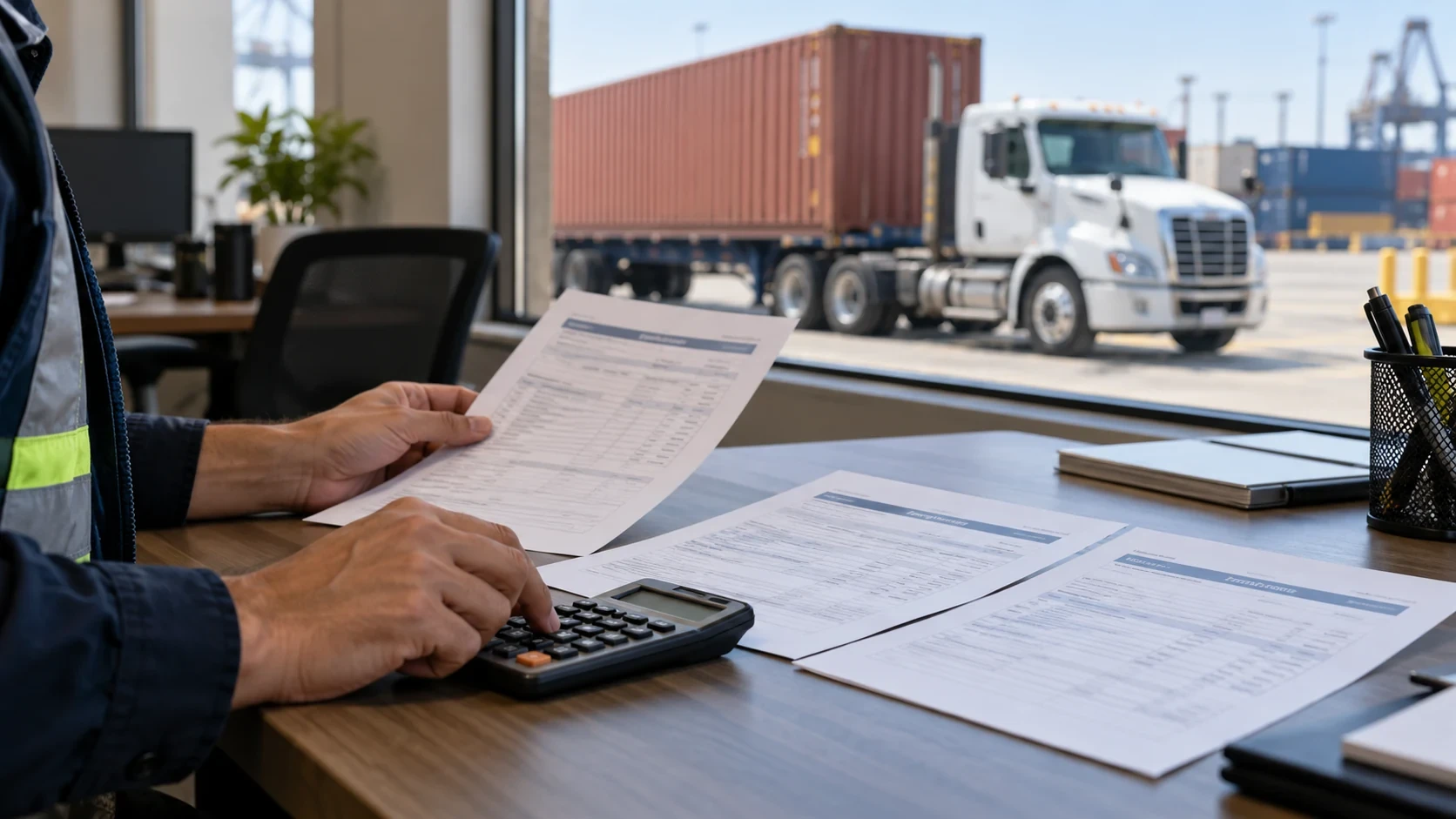
Two Long Beach drayage quotes can show different prices because they cover different assumptions. One may include fuel and a specified amount of chassis usage, while another lists those separately. A lower base rate is not enough to tell you which quote offers the lower expected cost.
Before comparing providers, put both quotes against the same shipment details: pickup terminal, delivery address, container size and weight, receiving arrangements and empty-return scope. This guide provides a practical way to compare what is included, what is separate and what could become payable if the move changes.
Quick Answer
Ask each Long Beach drayage company to identify its base transportation charge, fuel treatment, chassis terms, waiting-time allowance, delivery method and empty-return scope. Have applicable third-party charges and conditional accessorials listed separately.
Compare the expected total under the same assumptions, then review the charges that could apply if those assumptions change. “All-in” is useful only when the written quote explains what it includes and excludes.
Give Every Carrier the Same Shipment Details
A useful comparison starts before the quotes arrive. Send the same information to each provider so one is not pricing a straightforward live unload while another assumes a pre-pull and a later delivery.
Include:
- Import or export direction, pickup terminal and delivery address.
- Container quantity, size, type and accurate weight information.
- Container number, ocean carrier and relevant shipment dates when available.
- Release status and Last Free Day information, identifying anything still pending.
- Warehouse receiving hours, appointment requirements and unloading arrangements.
- Any requested staging, extra stops or unusual equipment requirements.
Ask how the quote changes if a pending detail turns out differently. A preliminary estimate based on incomplete information should not be compared as though it were a confirmed price for fully defined work.
For a broader explanation of pricing factors, read our port drayage cost guide.
Use This Side-by-Side Quote Checklist
For every line below, record the amount or calculation method and label it included, separately billed, conditional or not applicable. A blank line is a question to resolve, not proof that the service is free.
| Quote item | What to confirm with each carrier |
|---|---|
| Base transportation | Which pickup, delivery and return movements does the quoted transportation charge cover? |
| Fuel surcharge | Is fuel included or separate? If separate, what is the calculation basis and can it change before dispatch? |
| Chassis usage | How many days are included, if any? What daily rate, minimum and day-counting rules apply? |
| Chassis split or repositioning | What additional equipment movement triggers a charge, and how is it priced? |
| PierPass/TMF and Clean Truck Fund | Which charges apply, who pays them and are they included or passed through separately? |
| Terminal waiting time | What time is included, when does the clock start and what billing increment applies afterward? |
| Warehouse waiting time | What unloading time is included and how are additional time and delivery appointments handled? |
| Pre-pull and storage | Are extra handling and storage separate? How many storage days are assumed and what additional chassis usage may apply? |
| Delivery and empty return | Is the quote for live unload or drop-and-pick, and what does it assume about retrieving and returning the empty? |
| Exceptions and validity | What triggers dry-run, cancellation, redelivery or extra-stop charges, and when does the quote expire? |
Ask for explanations in writing before approving the move. Clear exclusions are more useful than an attractive headline price with unresolved terms.
Separate Carrier Charges From Third-Party Charges
A quote may combine the carrier’s services with amounts collected for another party. Ask which items are carrier charges, which are third-party charges and whether any payment-advance or administrative fee applies.
PierPass’s Traffic Mitigation Fee and the Clean Truck Fund rate are separate programs. Do not assume both apply to every container, or that mentioning them in a quote means payment has already been made.
PierPass publishes its fee and exemption information in its OffPeak FAQ. For shipment planning, confirm the applicable requirements and who is responsible for payment.
Avoid counting the same third-party charge twice when comparing a carrier’s quote with payments already arranged by your forwarder or another party.
Distinguish Driver Waiting Time From Container Detention
The word “detention” can create confusion because a trucking quote may use it for driver waiting time, while an ocean carrier may use detention or per diem for container use outside the terminal.
Ask the issuer to define the charge, the party billing it and the event that starts the clock.
For comparison purposes, keep three separate lines:
- Driver waiting time at the terminal or receiving facility.
- Demurrage associated with terminal storage beyond applicable free time.
- Ocean-container detention or per diem associated with equipment use beyond applicable free time.
Terminology and billing arrangements vary. Do not assume a driver’s included waiting-time allowance gives you additional container free days.
Compare Live Unload and Drop-and-Pick on Equal Terms
With a live unload, the driver generally remains while the receiving facility unloads. With drop-and-pick, the loaded container is left under an agreed arrangement and retrieved later.
Neither method should be assumed to have the lower total cost. A drop arrangement may involve additional truck movements, chassis time or other charges. A live unload may incur waiting time if unloading exceeds the included allowance.
Confirm the warehouse can accept the proposed method, when unloading will finish and how the carrier will be notified that the container is empty.
See our live unload vs. drop-and-pick guide for the operational differences.
Example: A Lower Base Rate Can Produce a Higher Expected Total
The following figures are invented solely to demonstrate the comparison method. They are not ITZON TRANSPORT rates, market averages or an offer of service.
Assume both quotes cover the same transportation movements and a two-day chassis requirement. Neither scenario requires waiting beyond the included allowance, storage or other extras.
| Comparison item | Quote A | Quote B |
|---|---|---|
| Transportation and fuel | $500 transportation plus $50 fuel | $600 including fuel |
| Chassis for the assumed two days | $45 per day × 2 = $90 | Two days included |
| Comparable subtotal | $640 | $600 |
| Applicable third-party charges | Not included; add after confirmation | Not included; add after confirmation |
Quote A starts with the lower transportation figure but has a higher subtotal under these assumptions. This does not make Quote B universally better: a different chassis duration, waiting-time allowance or return arrangement could change the comparison.
Keep contingent charges outside the assumed subtotal and show them clearly. An estimate is easier to assess when the known costs and possible extras are visible separately.
Ask What Happens When the Plan Changes
Port and warehouse conditions can change after a quote is accepted. Discuss how the carrier handles an unavailable container, a missed receiving appointment, changed return instructions or a request for staging.
Before booking, confirm:
- Which circumstances trigger additional charges.
- Whether approval is sought before discretionary extra services.
- Who receives updates and requests for approval.
- What records support time-based or extra-movement charges.
- How revised instructions and quote validity are handled.
Do not assume a special-service surcharge means a carrier can accept that shipment. Disclose hazardous cargo, unusual weights and equipment requirements before booking so capability and any necessary arrangements can be confirmed.
Request a Quote With Clear Assumptions
Once the comparison is complete, confirm the agreed scope and keep the written quote with your shipment records. Make sure the carrier and receiving facility are working from the same delivery instructions.
ITZON TRANSPORT provides Port of Long Beach container drayage to Southern California receiving facilities. Review our drayage services and service areas, then send the available shipment details for a quote.
If you are still evaluating providers, our carrier-selection checklist covers the broader questions to ask about experience, equipment and communication.
Frequently Asked Questions
Request a Long Beach Drayage Quote
Send your pickup terminal, delivery location, container details and receiving requirements so ITZON TRANSPORT can review the move.
Request a Quote →